Kratom and drug testing
It depends on the test, how much you took, how often you take it and your own body.
Kratom’s main alkaloid, mitragynine, is usually detectable in urine for days rather than hours, and regular use tends to stretch that window. There is no single number that applies to everyone, and no one can promise a test result.
This guide covers how the body processes kratom, the estimated detection windows for each test type and how drug testing actually works. If you are weighing whether kratom is right for you at all, start with our guide to is kratom safe.
21+ only Not approved by the FDA No test result guarantees
Written by Andrew Klein | Last updated October 9, 2026
Half-life and clearance
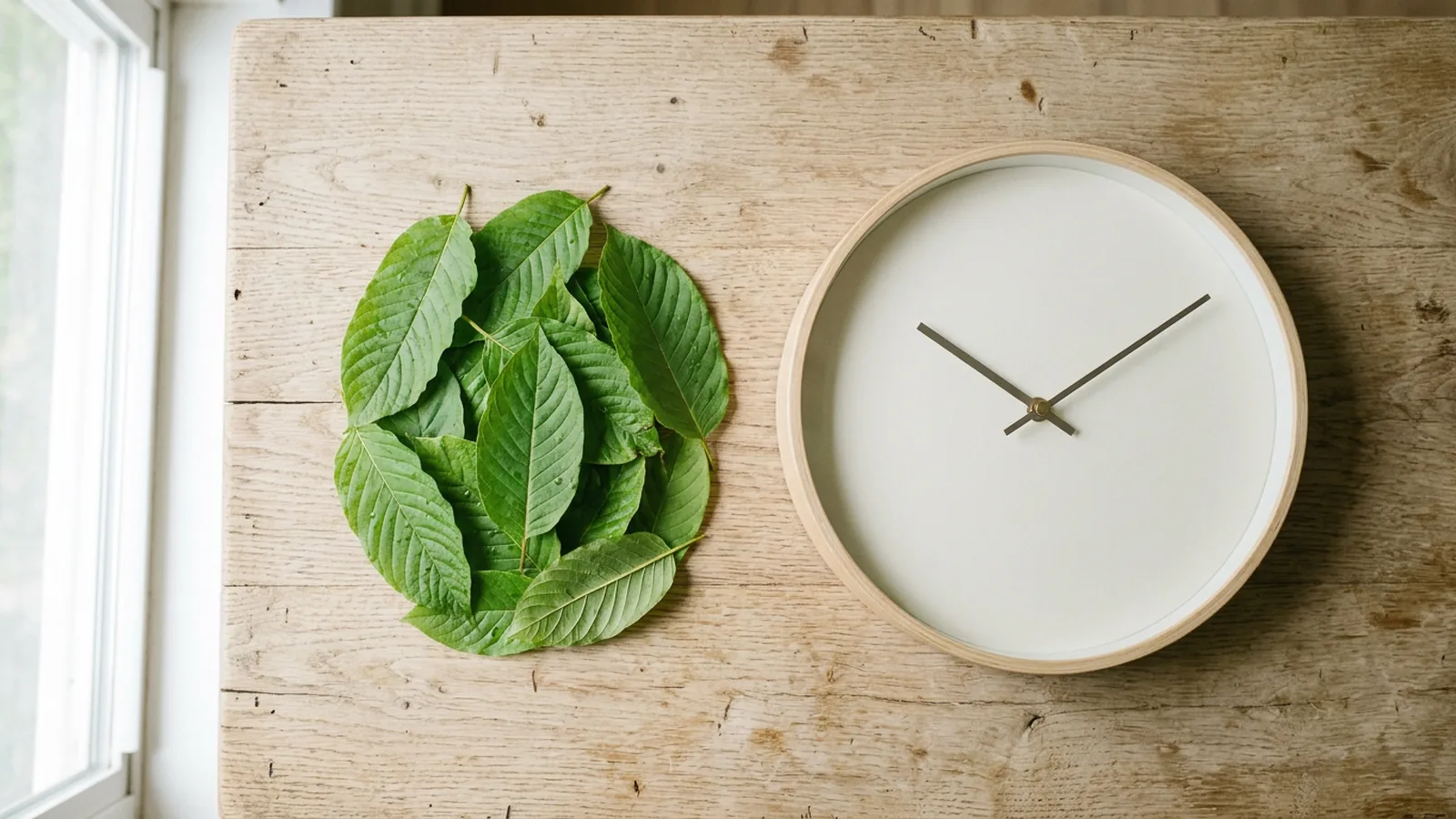
A half-life is the time it takes the body to reduce the amount of a compound in the blood by half. Human research on kratom is still limited. Small studies have reported mitragynine half-life estimates ranging from under a day to roughly two days, with longer figures seen after repeated use. That is why one serving and daily use can lead to very different detection times.
Rule of thumb: it takes around five half-lives for a compound to drop to very low levels. With a half-life of about a day, that is several days. With the longer estimates seen after repeated use, it can stretch further.
Mitragynine is processed mainly in the liver, where enzymes break it down into metabolites, including 7-hydroxymitragynine (7-OH). Those metabolites then leave the body mostly through urine. Because the liver does so much of this work, medications and other substances that affect liver enzymes may change how kratom is processed. That is one reason interactions matter, and our safety guide covers them in detail.
A note on 7-OH: small amounts form naturally in the body after taking natural leaf. That is different from concentrated 7-OH products sold in stores. Our guide to 7-OH vs kratom explains the difference.
Factors that change detection time
No two people clear kratom at the same rate. These are the main reasons why.
Amount taken
Larger amounts mean more alkaloids for the body to process. Our kratom serving size guide covers label servings and gram conversions.
How often you take it
With regular use, alkaloids can build up, which can extend detection windows well past what a single serving would produce.
Form
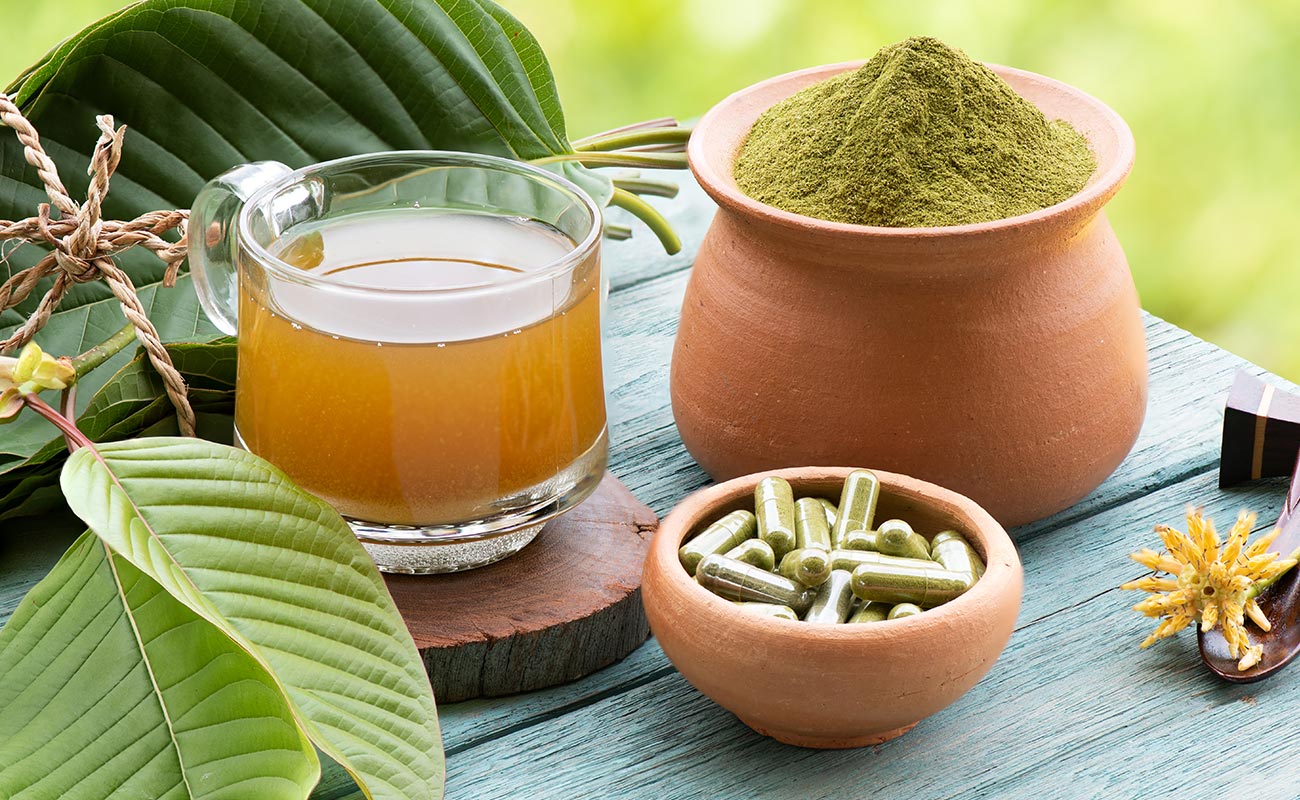
Capsules, powder and tea all deliver leaf alkaloids, but timing and amounts can differ by form. See how to take kratom for the basics.
Individual metabolism
Genetics and enzyme activity vary from person to person.
Body composition
Mitragynine is fat-soluble, so it may be stored and released more slowly in people with more body fat.
Age
Clearance often slows with age.
Liver and kidney function
These organs do most of the processing and removal. Reduced function can slow clearance significantly.
Other substances
Alcohol, medications and other products processed by the same liver enzymes may slow or alter how kratom is broken down. Do not combine kratom with alcohol or other substances.
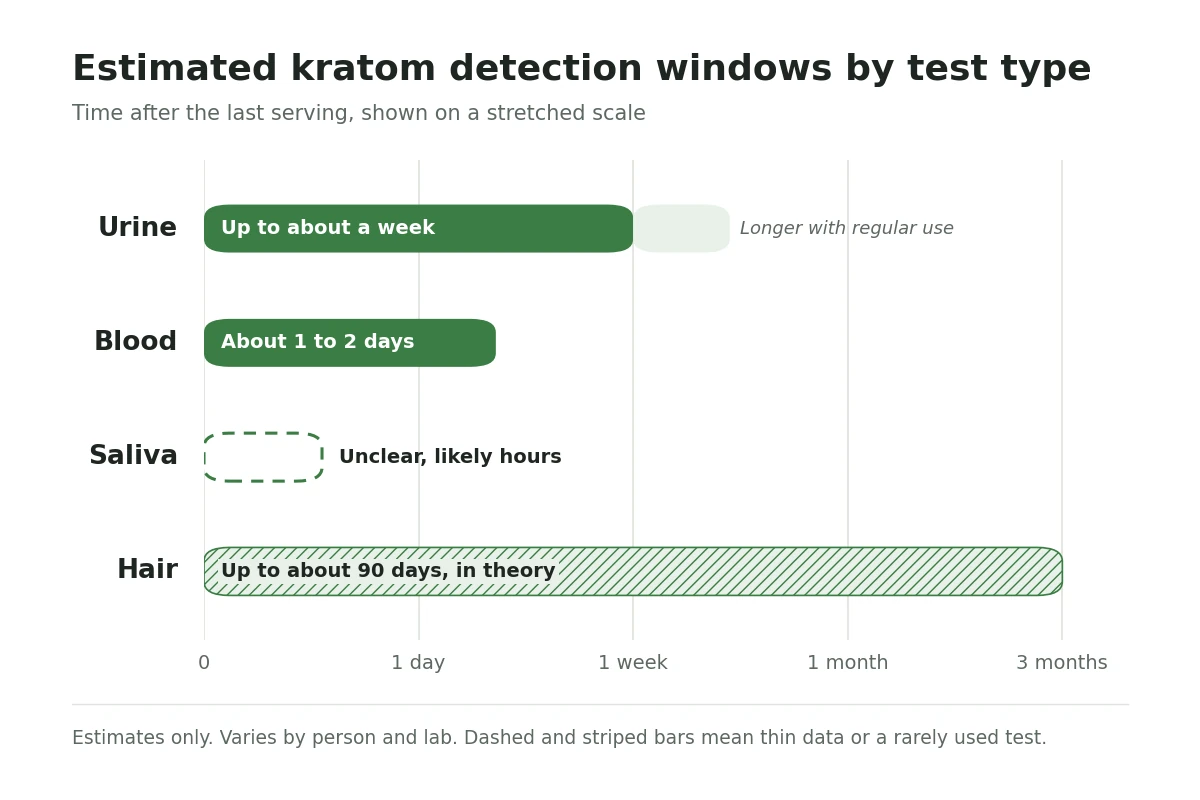
Detection windows by test type
| Test type | Estimated window | How common for kratom | Notes |
|---|---|---|---|
| Urine | Up to about a week; possibly longer with regular use | Most likely if kratom is tested at all | Requires a test that specifically looks for mitragynine |
| Blood | About 1 to 2 days | Uncommon; mostly clinical or forensic | Shorter window, more invasive |
| Saliva | Unclear; likely short | Rare | Very little published data |
| Hair | Up to about 90 days, in theory | Very rare | Not part of routine screening |
Every estimate in this table varies by person and by lab. Read it as background information, not a prediction for any individual test.
Drug tests: standard panels vs specific mitragynine tests
Standard 5- and 10-panel workplace screens usually do not test for kratom, but specific tests for mitragynine exist and some employers and programs use them. We cannot promise any test result.
Here is how testing generally works:
Standard panels
Look for specific drug classes such as amphetamines, cocaine, opiates and THC. Mitragynine is a different compound and is not on a typical standard panel.
Expanded panels
Can add mitragynine. Labs that offer these usually confirm results with methods such as liquid chromatography with mass spectrometry (LC-MS), which identify the exact compound present.
Confirmation testing
How labs tell one compound from another. A screening result is typically checked by a confirmation method before it is treated as final.
We do not give advice on passing, flushing or masking a drug test. If a test matters for your job, your legal situation or your health care, the honest path is to know the policy and be upfront about what you take.

Workplace, probation and recovery programs
Some settings are more likely than others to look for kratom:
Employers
Safety-sensitive industries may use expanded panels. Your employer’s drug policy or HR team can tell you what is tested.
Probation, parole and court programs
These often set their own testing rules and may prohibit kratom outright, whatever its status under state law.
Substance use recovery programs
These frequently test for kratom. If you are in a recovery program, kratom is not for you; talk with your care team.
Medical and emergency care
A full toxicology screen may include kratom. Always tell your healthcare provider if you use kratom.
Legal status and testing are separate questions. As of October 1, 2026, natural kratom leaf is not federally scheduled, while a DEA proposal to temporarily schedule concentrated 7-OH above a set threshold is still pending. Several states and local governments ban kratom outright. Check our kratom laws by state guide before ordering or traveling. Even where kratom is legal, an employer or program can still test for it and set its own rules.

Related reading
Label servings and capsule to gram conversions.
Known risks, interactions and who should avoid kratom.
Short answers on products, ordering and shipping.
Sources
- U.S. Food and Drug Administration, FDA and Kratom
- National Institute on Drug Abuse, Kratom
- Federal Register, notice of intent to temporarily schedule 7-OH above a specified threshold (DEA-1570), July 6, 2026
- Poison Control: 1-800-222-1222. SAMHSA National Helpline: 1-800-662-4357.
These statements have not been evaluated by the Food and Drug Administration. This product is not intended to diagnose, treat, cure, or prevent any disease. Must be 21 or older to purchase. Kratom is not approved by the FDA for any use. Do not use if pregnant, nursing, or taking medication, and consult a healthcare professional before use. Check your state and local laws before ordering.
Article Contents
- Quick answer: how long kratom stays in your system
- Half-life and clearance
- Factors that change detection time
- Detection windows by test type
- Drug tests: standard panels vs specific mitragynine tests
- Workplace, probation and recovery programs
- When to get help
- Frequently asked questions
- Related reading
- Shop and learn more
Subscribe
Get 15% off your first order.